When I was in college and graduate school, I often used to imagine what I would be doing ten years in the future. I would try to guess at where I would be working, what my family would look like, and what I would be like. I am now living in that future, and my life is nothing like I imagined it. I would never have predicted that I would be the pastor of a church in Roseburg, Oregon, with one son from Russia and a son and two daughters from Ethiopia.
Mark 11:1-11
“As they approached Jerusalem and came to Bethphage and Bethany at the Mount of Olives, Jesus sent two of his disciples, 2 saying to them, "Go to the village ahead of you, and just as you enter it, you will find a colt tied there, which no one has ever ridden. Untie it and bring it here. 3 If anyone asks you, 'Why are you doing this?' tell him, 'The Lord needs it and will send it back here shortly.'" 4 They went and found a colt outside in the street, tied at a doorway. As they untied it, 5 some people standing there asked, "What are you doing, untying that colt?" 6 They answered as Jesus had told them to, and the people let them go. 7 When they brought the colt to Jesus and threw their cloaks over it, he sat on it. 8 Many people spread their cloaks on the road, while others spread branches they had cut in the fields. 9 Those who went ahead and those who followed shouted, "Hosanna!" "Blessed is he who comes in the name of the Lord!" 10 "Blessed is the coming kingdom of our father David!" "Hosanna in the highest!" 11 Jesus entered Jerusalem and went to the temple. He looked around at everything, but since it was already late, he went out to Bethany with the Twelve."
The people recognized that a prophecy was being fulfilled here. Zechariah 9:9-10
“Rejoice greatly, O Daughter of Zion! Shout, Daughter of Jerusalem! See, your king comes to you, righteous and having salvation, gentle and riding on a donkey, on a colt, the foal of a donkey. 10 I will take away the chariots from Ephraim and the war-horses from Jerusalem, and the battle bow will be broken. He will proclaim peace to the nations. His rule will extend from sea to sea and from the River to the ends of the earth.”
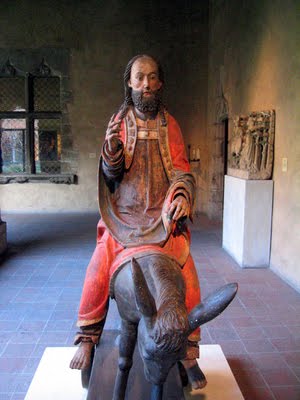
Why did Jesus ride a colt into Jerusalem, only to look around at the Temple and leave? It must have been somewhat disappointing to his disciples, and certainly to the crowds of people that had just cheered Him into the city. No doubt they expected Him to take charge of the Temple, rallying the people to revolt, and close the gates of the city so that traitors to Israel could not escape. They assumed He would continue the trajectory they saw Him taking as He traveled over palm branches.
But instead, He jumps down from the colt, looks around, and leaves. What kind of rallying cry is that? The people had to have been confused. “What was that all about?” “Why didn’t He kick down the door to the Roman garrison, or swing open the gates of the Temple, or make a speech?” “This guy isn’t who we thought He was.”
I don’t think Jesus was misleading anyone, I think people imagined a Messiah that fit their own expectations and hopes. They couldn’t dream of what was going through Jesus’ head as He looks around a city so recently in love with Him, and already in His mind hear the taunts, the insults, the loud ringing cries of “Crucify! Crucify!”
Wednesday, May 18, 2011
Tuesday, May 17, 2011
When you are engulfed in flames.
People interpret salvation in different ways. Most people I know think of salvation as an event, as in “When I got saved....” Most of these same people also do not believe they can lose that salvation once they have acquired it. This perspective has merit, and does have Scriptural backing, but in my opinion represents only a partial view of biblical salvation. To be sure, salvation is an event, just as the crucifixion was an event, but isn’t salvation also a process as well?Mark 9:36-50 “He took a little child and had him stand among them. Taking him in his arms, he said to them, 37 "Whoever welcomes one of these little children in my name welcomes me; and whoever welcomes me does not welcome me but the one who sent me." 38 "Teacher," said John, "we saw a man driving out demons in your name and we told him to stop, because he was not one of us." 39 "Do not stop him," Jesus said. "No one who does a miracle in my name can in the next moment say anything bad about me, 40 for whoever is not against us is for us. 41 I tell you the truth, anyone who gives you a cup of water in my name because you belong to Christ will certainly not lose his reward. 42 "And if anyone causes one of these little ones who believe in me to sin, it would be better for him to be thrown into the sea with a large millstone tied around his neck. 43 If your hand causes you to sin, cut it off. It is better for you to enter life maimed than with two hands to go into hell, where the fire never goes out. 45 And if your foot causes you to sin, cut it off. It is better for you to enter life crippled than to have two feet and be thrown into hell. 47 And if your eye causes you to sin, pluck it out. It is better for you to enter the kingdom of God with one eye than to have two eyes and be thrown into hell, 48 where "'their worm does not die, and the fire is not quenched.' 49 Everyone will be salted with fire. 50 "Salt is good, but if it loses its saltiness, how can you make it salty again? Have salt in yourselves, and be at peace with each other.”
As humans with rational, finite minds, we like ideas to be nice and tidy. We live in an era of the sound bite, the bumpersticker, and the media spin. We are uncomfortable with tension and live in denial of grey areas. Our need to get a handle on things is embedded deep in our psyche. God knows this, and that is precisely why the Christian faith as revealed by Him is defined as mystery, not doctrine, as recorded in the Scriptures.
Our need for faith to be neat and tidy spills over into our opinion of others as well. The disciples, still in self-absorbed mode here, find out that someone else is cashing in on the Jesus phenomenon. Someone else is handing out business cards that read, “Jim, son of Lance, representative of Jesus Messiah.” This information finds the disciples already riled up about positions of control and power. They don’t like it, and they want this imposter dealt with by the Master Himself. They cannot conceive that someone outside their elite group could be a genuine exorcist.
But Jesus is always smashing in the cubbyholes. He is always throwing the file cabinet on the trash heap. With Jesus, very little is defined, except submission and discipleship. Everything else is under those two requirements.
Faith and salvation are best defined by fire. Fire is basically a chemical reaction: the rapid oxidizing of organic material. Fire is also hard to control. It hypnotizes you with its constant movement. In the Scriptures, fire is used to illustrate two key concepts – destruction of the rebellious and purification of the devoted. Both undergo a passage through fire. Here Jesus refers to both groups, and how it is better to sacrifice and be scorched by the Holy Spirit than to go whole into the fire of Hell.
Monday, May 16, 2011
The Ruined Snail
My parents divorced when I was 34. I was not surprised. Things had been extraordinarily dysfunctional for a long time. I tried to help for years, but unless people want to change, they just won’t. I have had to figure out how to interact with them as separate individuals. Things have normalized to some degree, but it will always be a little weird. My mother has since remarried and is very happy. Her husband is a good man who treats her very well. My father is in a better place in his life now, after six years. He talks about getting remarried some day.
Mark 10:1-16
"Jesus then left that place and went into the region of Judea and across the Jordan. Again crowds of people came to him, and as was his custom, he taught them. 2 Some Pharisees came and tested him by asking, "Is it lawful for a man to divorce his wife?"3 "What did Moses command you?" he replied. 4 They said, "Moses permitted a man to write a certificate of divorce and send her away." 5 "It was because your hearts were hard that Moses wrote you this law," Jesus replied. 6 "But at the beginning of creation God 'made them male and female.' 7'For this reason a man will leave his father and mother and be united to his wife, 8 and the two will become one flesh.' So they are no longer two, but one. 9 Therefore what God has joined together, let man not separate." 10 When they were in the house again, the disciples asked Jesus about this. 11 He answered, "Anyone who divorces his wife and marries another woman commits adultery against her. 12 And if she divorces her husband and marries another man, she commits adultery." 13 People were bringing little children to Jesus to have him touch them, but the disciples rebuked them. 14 When Jesus saw this, he was indignant. He said to them, "Let the little children come to me, and do not hinder them, for the kingdom of God belongs to such as these. 15 I tell you the truth, anyone who will not receive the kingdom of God like a little child will never enter it." 16 And he took the children in his arms, put his hands on them and blessed them."
When I was a kid, I played in my backyard a lot, especially with bugs and other creatures I would find. One time I came upon two snails in the process of mating. Snails are hermaphroditic, they have both male and female sexual organs. When they mate, snails put out these long tendrils that look a lot like tiny roots and literally lace themselves together. In my sadistic boyhood manner, I pulled them apart. I tore them from each other, breaking the bonds they had so intricately woven. In doing so, I destroyed them both.
God hates divorce, he says so in Malachi 2. God hates division, he hates separation, walls, and exclusion, and therefore he hates divorce as the pinnacle of division. It was not his intention for man and woman, once joined, to be ripped apart. It destroys them both. Divorce also has a tremendous impact on children. The damage done depends on the age of the child and the circumstances involved, both before and after. Adolescence is the worst possible time for parents to divorce. The broad consensus is that adolescent children will be irrevocably altered, in mostly negative ways, by divorce. Children derive a good deal of their worldview and identity from their parents, and divorce disrupts these things in a massive way.
Jesus didn’t like the disciples acting like his minders and gatekeepers. It says he was indignant, but the Greek word means a combination of anger and grief. He was angry and grieved because the disciples weren’t letting those kids through. I like to think it was because the disciples still weren’t getting the idea, but I think Jesus was also angry and grieved because no one, then or today, takes kids and their feelings very seriously. Even parents, sometimes.
Sunday, May 15, 2011
The Holy Spirit is in Your Genes
I have often wondered at the path the Lord has led me on. I did not end up anywhere near where I initially set out from. For most of my childhood and adolescence, I wanted to be a genetic engineer. I wanted to help decipher the codes that make up who we are as human beings. I love science, particularly biology.
But halfway through an undergraduate program in biology, God changed the direction in which I was heading. I did not end up being a genetic engineer, I ended up being a pastor, something I had not even conceived of when I started college.
Mark 9:30-37
“They left that place and passed through Galilee. Jesus did not want anyone to know where they were, 31 because he was teaching his disciples. He said to them, "The Son of Man is going to be betrayed into the hands of men. They will kill him, and after three days he will rise." 32 But they did not understand what he meant and were afraid to ask him about it. 33 They came to Capernaum. When he was in the house, he asked them, "What were you arguing about on the road?" 34 But they kept quiet because on the way they had argued about who was the greatest. 35 Sitting down, Jesus called the Twelve and said, "If anyone wants to be first, he must be the very last, and the servant of all." 36 He took a little child and had him stand among them. Taking him in his arms, he said to them, 37 "Whoever welcomes one of these little children in my name welcomes me; and whoever welcomes me does not welcome me but the one who sent me."
Now, its not like I received a vision or anything like that, although sometimes I wish I would. I started out with a certain set of assumptions about who I was and where I was going, but as my life cohabitated with the Holy Spirit, those assumptions began to transform. I began to realize that what God had in store for me was so much more than my little plans could contain. Slowly, I began to understand the path He wanted me to take. My assumptions began to totally recede into the background, until for the most part I let God guide me into where He wanted me to be.
The disciples had a certain set of assumptions as well. Every student of ancient history knows that the Jews were waiting for a political savior to throw off the iron yoke of the Romans. But while this may have been in the background, I really doubt the disciples were focused on Jesus as the next President of Palestine. It becomes clear in this passage that their ambitions and desires were much smaller, much more embarrassingly self-centered. They were each vying for position as favored one in the New Regime. And, typically for us humans, it was poorly timed, since Jesus had just told them He was going to be killed. Jesus had revealed much bigger plans for the human race, but their grasping, miserly little minds couldn’t handle it.
Saturday, May 14, 2011
The Sugary-Coated Truth
I sometimes wonder if I am too blunt with people. I was raised in a family that spoke what they were thinking, a lot of the time to their detriment. As I have matured I have been able to reign in that impulse to a pretty great degree, but there are times when I wonder if I said something a little too soon or a little too harshly. Because compassion is not at the top of my list of spiritual gifts, I have a tendency to only go so far with people before I cut to the chase.
Mark 6:12-29
“They went out and preached that people should repent. 13 They drove out many demons and anointed many sick people with oil and healed them. 14 King Herod heard about this, for Jesus' name had become well known. Some were saying,"John the Baptist has been raised from the dead, and that is why miraculous powers are at work in him." 15 Others said, "He is Elijah." And still others claimed, "He is a prophet, like one of the prophets of long ago." 16 But when Herod heard this, he said, "John, the man I beheaded, has been raised from the dead!" 17 For Herod himself had given orders to have John arrested, and he had him bound and put in prison. He did this because of Herodias, his brother Philip's wife, whom he had married. 18 For John had been saying to Herod, "It is not lawful for you to have your brother's wife." 19 So Herodias nursed a grudge against John and wanted to kill him. But she was not able to, 20 because Herod feared John and protected him, knowing him to be a righteous and holy man. When Herod heard John, he was greatly puzzled; yet he liked to listen to him. 21 Finally the opportune time came. On his birthday Herod gave a banquet for his high officials and military commanders and the leading men of Galilee. 22 When the daughter of Herodias came in and danced, she pleased Herod and his dinner guests. The king said to the girl, "Ask me for anything you want, and I'll give it to you." 23 And he promised her with an oath, "Whatever you ask I will give you, up to half my kingdom." 24 She went out and said to her mother, "What shall I ask for?" "The head of John the Baptist," she answered. 25 At once the girl hurried in to the king with the request: "I want you to give me right now the head of John the Baptist on a platter." 26 The king was greatly distressed, but because of his oaths and his dinner guests, he did not want to refuse her. 27 So he immediately sent an executioner with orders to bring John's head. The man went, beheaded John in the prison, 28 and brought back his head on a platter. He presented it to the girl, and she gave it to her mother. 29 On hearing of this, John's disciples came and took his body and laid it in a tomb.”
John the Baptist had a bluntness issue as well. As the last of the “old school” prophets, John was not one to beat around the bush. Everything he said was right to the point. Perhaps this is why Herod kept him around so long, as it says “he was greatly puzzled; yet he liked to listen to him.” But John’s role was to speak the truth, and it got him killed. People don’t like to hear the truth in undiluted form. People like to hear the truth padded with niceties and flattering words so it is easier to swallow. John the Baptist is one of the most interesting people in the Bible. His prophetic career as it is recorded was short, perhaps even shorter than Jesus’. But his fiery words and unforgettable persona reach out and grab you by both ears and pull you in close. He spoke the truth, it would be nice if we could too, but it might get us killed.
Friday, May 13, 2011
Wear some heavy boots this time
I believe, as Friedrich Nietzsche shrewdly pointed out, that humanity’s primal sin is the lust for power. The Garden of Eden story tells us the real temptation for Adam and Eve was not that the fruit of the tree of knowledge of good and evil looked just so yummy they couldn’t resist, rather it was what the serpent said eating the fruit would allow them to do. "You will not surely die," the serpent said to the woman. “For God knows that when you eat of it your eyes will be opened, and you will be like God, knowing good and evil." Genesis 3:4-5.
And so begins millennia of humans’ attempts at domination.
Mark 6:6-13
“Then Jesus went around teaching from village to village. 7 Calling the Twelve to him, he sent them out two by two and gave them authority over evil spirits. 8 These were his instructions: "Take nothing for the journey except a staff-no bread, no bag, no money in your belts. 9 Wear sandals but not an extra tunic. 10 Whenever you enter a house, stay there until you leave that town. 11 And if any place will not welcome you or listen to you, shake the dust off your feet when you leave, as a testimony against them." 12 They went out and preached that people should repent. 13 They drove out many demons and anointed many sick people with oil and healed them.”
But we have been deluded and deceived by the serpent ever since as well. Most of us quickly forget that Jesus is the only authentic source of power in the universe. And that power can be given to us, but never taken by us. He remains in control even as we become mighty in the Spirit. We become like rays of the sun, shooting across the darkness of space.
And our mission? It is serious business: to destroy the strongholds of the serpent, to release the slaves he has captured, to proclaim a message that hope remains firmly within our grasp, and to grind under millions of faithful heels the head of that ancient snake. Eat dust, serpent!
Thursday, May 12, 2011
Your hometown is only a memory
When I was sixteen, our family moved from southern California to southern Oregon. This was good and bad. The good part was I wasn’t happy with who I was in California and needed a way to reinvent myself. The bad part was the person I became was even worse. Let’s just say you wouldn’t have wanted to know me back then, and leave it at that, ok?
Pretty soon I had burned what few bridges I had and was a loner, this time of my own doing. In my adolescent brain I became convinced that my entire town hated me. This, I felt, was deserved. It took several years of not living there to realize that most people neither knew nor cared about me or my lack of moral fiber. Even today, when I return home, I still have lingering fears of meeting someone who knew the Ryan of the past.
Mark 6:1-6
“Jesus left there and went to his hometown, accompanied by his disciples. 2 When the Sabbath came, he began to teach in the synagogue, and many who heard him were amazed. "Where did this man get these things?" they asked. "What's this wisdom that has been given him, that he even does miracles! 3 Isn't this the carpenter? Isn't this Mary's son and the brother of James, Joseph, Judas and Simon? Aren't his sisters here with us?" And they took offense at him. 4 Jesus said to them, "Only in his hometown, among his relatives and in his own house is a prophet without honor." 5 He could not do any miracles there, except lay his hands on a few sick people and heal them. 6 And he was amazed at their lack of faith.”
I recently heard someone speak who grew up in a town of 98 people, most of them related to him somehow. My own hometown runs around 3,000. Nazareth was probably similar in size. Small towns, like mine and maybe Jesus’, are often touted in nostalgic terms. People remember the close-knit community of their childhood, where everyone had time to sit out on the front porch and lean over backyard fences to chat with the neighbors. I imagine Nazareth being this way.
Unfortunately, that kind of town only exists in memories whitewashed with time. While there are undoubtedly many good things about living in a small town, there are many problems too. One of these problems is that a person can never really escape their past in a small town. No matter how many years go by or whether you stay or move away, you remain to a large degree who you were before. This is exactly what Jesus is facing here. The Greek word for the townspeople’s reaction to Jesus the Messiah is the same word we use for scandal. They considered it a scandal that this carpenter’s son comes home all high and mighty with notions of being One with authority. They found it offensive to their definition of who Jesus was.
The text says Jesus was unable to perform many miracles there, outside of a few healings. He was amazed at their lack of faith. He didn’t come back very often after that. I suspect that is one reason so many today don’t either.
Subscribe to:
Posts (Atom)


